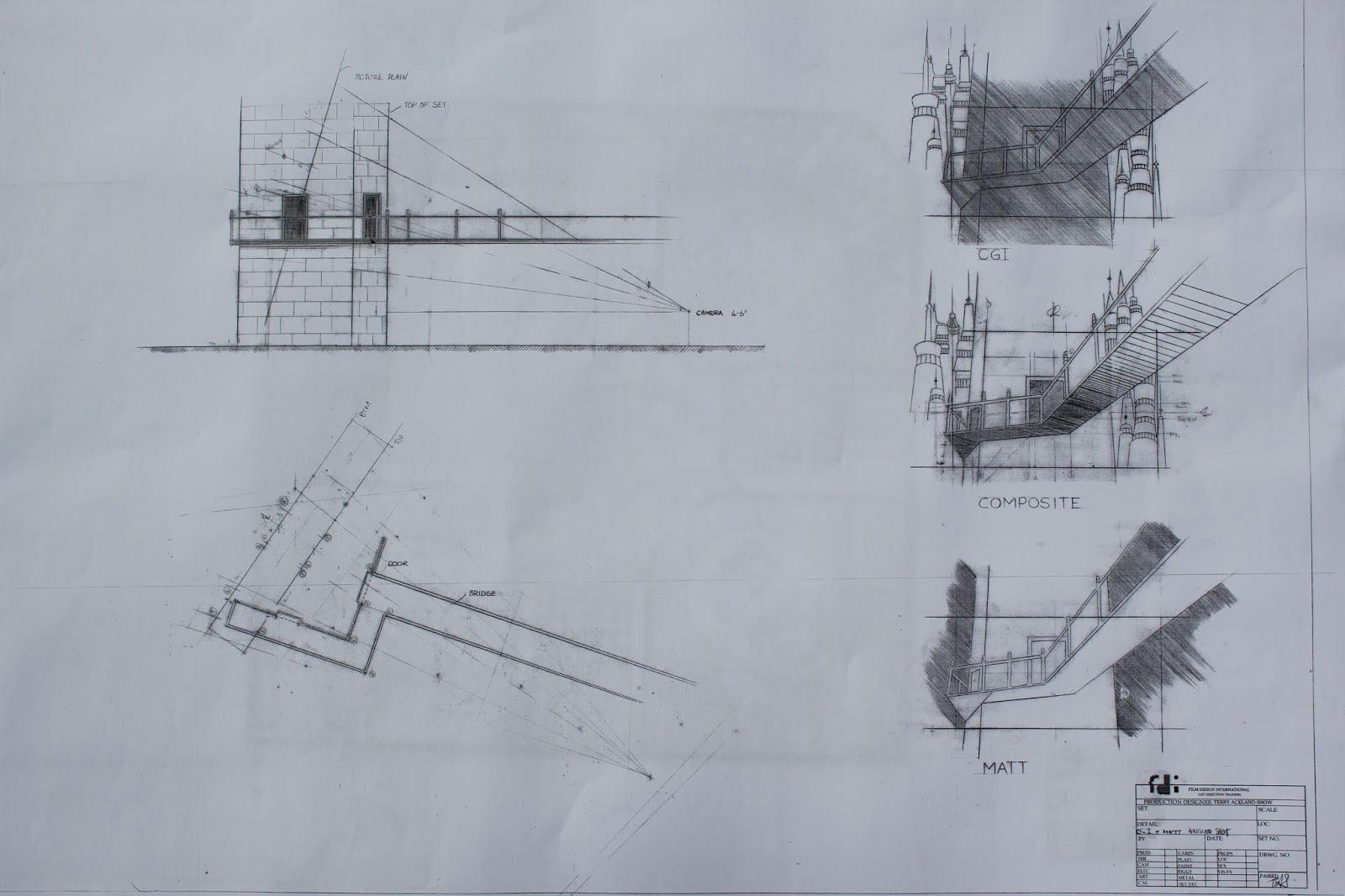
The following drawings compliment my PDF CV and represent my qualifying drawings for both the basic and advanced certificates in Draughtsmanship for the Entertainment Industry at Film Design International, Pinewood Studios; and also showcase my abilities in sketching and Oil Painting.
The Draughtsmanship work, represents a series of key exercises in the ability to produce an accurate set of working drawings, plans sections and elevations; and the ability to draw up an accurate survey of any given location. The drawings showcase an understanding of false perspectives, working to scale, and the fabrication of accurate, scaled models.
Please click on drawings for detailed enlargements.
Friday, 6 September 2013

Wednesday, 4 September 2013




Saturday, 18 February 2012
Un-zipping the Bat-suit: The Material Culture of the Batman
My thesis
discusses how the Batsuit and its accessories and representations, articulate and inform not only the character
Batman, but an entire culture of creative and professional identities, across
Film Industry and Fandom, through processes of object manufacture, circulation
and collection. The importance of the suit to the characterization has not been
sufficiently explored, for arguably, without the Batsuit, there is no Batman. For
the character Batman to be deployed, a Batsuit must first be created. This
process happens narratively – within the fiction – and materially –in the
creation of the fiction. Historically, the Batsuit has always been created prior to the
narrative construction of character, and was originally based upon a sketch of a suit created by artist Bob Kane and writer Bill Finger. The latest series of Batman films' were similarly based around Christopher Nolan's vision of the Tumbler vehicle, which was first designed to function as a metonymic symbol for his fresh approach to the characterisation. From
the early comic books to the current blockbuster movies, the material culture of the Batman has always been developed before a the character is symbolically
constructed in narrative.
Existing Batman scholarship does not give appropriate consideration to the material culture and instead discusses the distribution, reception or interpretation of the textual form, or issues surrounding the character and the narrative. Batman has been popularly analyzed using a semiotic approach. However, the problem with using a theory of representation to study Batman is that all perspectives can be argued as equally valid, given the appropriate context and interpretive audience. This form of analysis also ignores what I had previously observed as the fundamental importance of the Batsuit to the structure and maintenance of fan identity and fan cultures. My extended study began by researching the manufacture, circulation and collection of various forms of film and television memorabilia and with this information, addressing the denigration of consumption in fan studies. By engaging with private collectors, commercial circulators and domestic fabricators and also working regularly at UK fan contentions, I made a contemporary assessment of the ascription of collectable value and its relevance to the structure of fan cultures. I observed that fan cultures are structured around the manufacture, circulation and collection of objects. Predominantly, Fandom isn’t about the text - the narrative and its reception – it’s about ‘stuff’ and people’s relationship with it. Eventually my work became focused upon ‘Batman’ as an illustrative example of a fan culture, which is principally based around the manufacture, circulation and collection of the Batsuit, its accessories and representations.
Existing Batman scholarship does not give appropriate consideration to the material culture and instead discusses the distribution, reception or interpretation of the textual form, or issues surrounding the character and the narrative. Batman has been popularly analyzed using a semiotic approach. However, the problem with using a theory of representation to study Batman is that all perspectives can be argued as equally valid, given the appropriate context and interpretive audience. This form of analysis also ignores what I had previously observed as the fundamental importance of the Batsuit to the structure and maintenance of fan identity and fan cultures. My extended study began by researching the manufacture, circulation and collection of various forms of film and television memorabilia and with this information, addressing the denigration of consumption in fan studies. By engaging with private collectors, commercial circulators and domestic fabricators and also working regularly at UK fan contentions, I made a contemporary assessment of the ascription of collectable value and its relevance to the structure of fan cultures. I observed that fan cultures are structured around the manufacture, circulation and collection of objects. Predominantly, Fandom isn’t about the text - the narrative and its reception – it’s about ‘stuff’ and people’s relationship with it. Eventually my work became focused upon ‘Batman’ as an illustrative example of a fan culture, which is principally based around the manufacture, circulation and collection of the Batsuit, its accessories and representations.
As my
study evolved, my research has led me into the Film Industry to meet those
involved with the manufacture of the suits and accessories, and investigate to what extent the Batman character is structured around the design, manufacture, use and critical and cultural reception of the suit. My approach developed
from what began as simply ‘an opportunistic methodology’ to what Caldwell terms
‘an integrated cultural-industrial method of analysis’. This ‘synthetic
approach’ utilises data from different modes of analysis, principally material
culture studies and textual analysis, and incorporates interviews with
manufacturers, circulators and collectors of the Batsuit and its accessories,
from different positions in Industrial Art Departments, high street marketing
and fan culture. These individual research modes are kept ‘in check’ through
the different chapters by placing discourses, discussions and interviews in
dialogue with the others, whilst always returning the principal enquiries of
each chapter to the objective evidence of the material culture. ‘Unzipping the Batsuit’ reveals the
rich developmental history of Batman’s costume, car and gadgets, a fantastic
material culture that blurs the boundaries of fantasy and reality, creative
industry and commerce, critical analysis and fandom, and provides a fresh
perspective on the way that we examine the generation and maintenance of fan cultures.
Thursday, 4 November 2010
Batman '89: Anton Furst's Gargoyle

Gotham City, always brings a smile to my face ...
I have recently been fortunate enough to acquire one of the Gargoyles from the Gotham City Cathedral, as it was represented in the first Batman film (1989). This post briefly discusses the history of the gargoyle and what it means to me, its new owner. Batman ’89, as it is affectionately called, was Tim Burton's first big budget picture, cronologicaly situated in between Beetlejuice (1988) and Edward Sissorhands (1990). In 1990, Anton Furst’s unique, visionary, set design, won Batman ’89 it’s only Academy Award for Best Art Direction and Set Decoration. Furst's masterwork was to carry Burton's hollywood-gothisism into the future and change the look of all subsequent superhero movies.
The production was plagued with problems and Burton repeatedly clashed with Producers Jon Peters and Peter Guber over casting issues. After working together on Beetlejuice, Burton cast Michael Keaton as Batman, working on the logic that Batman was a regular guy. This proved to be such an unpopular choice with fans that shares in Warner Brothers took a nose dive. Yet Warner Bros. gambled on Batman and backed the movie with one of the biggest market and merchandising campaigns in history. The movie became one of the biggest grossing box office hits of all time, grossing over $250 million in US and $400 million worldwide.
Perhaps the greatest achievement of this picture was its artistic influence. This film totally changed the style of superhero movies. Before Burton’s Batman, Superman was considered the absolute pinnacle of superhero movies. Future movies began to eschew the heroism of Richard Donner’s all American Superman for more realistic characters with psychological depth. By questioning the nature of heroism Burton’s Batman paved the way for a darker portrayal of Batman on TV, in the awesome long running Batman: The Animated Series.

You can see my Gargoyle in the final climactic scenes of the movie. It is perched high atop Gotham Cathedral, where the Joker, as played by Jack Nickelson waltzes with Vikkie Vale (Michelle Pfeiffer), before being tethered to another Gargoyle and taking a dive from the building. The Joker hangs his hat and coat on one wing, and the gargoyle moves from background to forground as the couple dance around.
In the original script, there was no Gotham Cathedral. Movie producer Jon Peters reworked the climax of the movie into something more mainstream without first telling Burton. In the original ending, the Joker was supposed to kill Vikkie Vale sending Batman into a vengeful rage. Instead, Peters plotted the Jokers dramatic demise and commissioned Furst to create a 38 feet high model (12m) of Gotham Cathedral. The cathedral, of which the Gargoyle is a crowning part, cost 100,000 pounds when the film was already way over budget. Burton hated having no scripted idea as to how the film would end. In the book Burton on Burton, he writes
Here were Jack Nicholson and Kim Basinger walking up this cathedral, and halfway up Jack turns around and says, 'Why am I walking up all these stairs? Where am I going?' 'We'll talk about it when you get to the top!' I had to tell him that I didn't know.
The Cathedral is a key dramatic device in the film. One of the problems Anton faced was to create a cathedral which looked taller than the tallest skyscraper and still make it look credible. It had to appear to be over 1,000 feet (300 metres) high. In designing the structure, Furst has stated that he was primarily influenced by some of the 1930s skyscrapers in New York, which produced a cathedral effect at the top by means of interesting Gothic detail. In his design he was also influenced by Gaudi, the now-feted Spanish architect who is best known for his cone-shaped cathedral in Barcelona. There is no Gothic, Norman, or any other cathedral reference in Gaudi's masterpiece, so its sense of timelessness appealed to Furst and thus fitted the tone of the film. Furst writes
I basically stretched Gaudi into a skyscraper and added a castle feel which was especially influenced by the look of the Japanese fortress. The top deck of the Cathedral is strongly evocative of Hitchcock's house, a favourite image, as it happens, of Tim Burton's. The dangerous parapets, as well as the cantilevered belfry, fit the malevolent heart of a city which God left 100 years before. Yet the augmented and exaggerated design, whose unreality still had to be made credible, also suggests the comic absurdity which is evident in the film.

Twenty one years the after the destruction of the cathedral, the gargoyle turned up on eBay. After leaving Pinewood Studios, the sculpture made its way to Bude, Cornwall and was bought by a Cambridge tattoo artist for his young gothic daughter. The artist had been shopping with his family for a pine dining table, and had gone into a wholesale style furniture store, run –on a temporary basis – by a Londoner looking to make a few sovs. The main bulk of stock was pine furniture, but alongside this was a lorry load of props from Pinewood studios. The artist told me that there were many Egyptian style props, chariots, sarcophagi and the like. Twenty one years ago, there was no real market for used movie props, no such thing as ‘certificates of authenticity’, actually there was no such thing as the internet or a mobile phone. The furniture dealer took a risk in landing himself with what was potentially a truck load of unsalable junk, perhaps thinking it would bring customers into his store, where he could sell them some furniture. Indeed, the artist and his family left with both a fine pine table and the gargoyle. The young lady named the sculpture ‘Sid’, and he lived with her, in the corner of her room all her formative years.

Sid is hand made – not cast - from plaster wood and wire, which has then been ‘artexed’ with a thick paint, giving it the ‘stone’ texture that you can see. Despite not being made of stone, Sid is heavy, and needs two grown men to move him around. Sid is too fragile to be sent by courier, so I climbed in the Batmobile and made the eight hundred mile round trip in a day. Four feet tall at a squat, this lonely sentinel of the crime ridden city would no doubt rise to over eight feet if he were to stand up and take flight...and what a sight that would be, from the balcony of my second floor flat...fly my pretty, fly... and how bittersweet it would be to have such a Gollum arise and do your bidding...but I digress, this could easily get fruity. This is such a beautiful object of contemplation.

Of course the Gargoyle could mean many things to many people. I find the work resonating with August Rodin’s ‘The Poet’. This famous sculpture, often referred to as ‘the Thinker’ was commissioned by the Musee des Arts Decoratifs, Paris, in the late nineteenth century. The thinker has become an iconic image, signifying intellectual activity and philosophical thought. Rodin was inspired by both Michelangelo and Dante, and the nude figure that sits in contemplation is thought to be Dante himself, sat in front of the gates of Hell, contemplating his great poem, ‘The Divine Comedy’. Of course Rodin first made a plaster model of ‘The Poet’ in 1880, before finally casting the full scale figure in Bronze, some twenty five years later. Today, there are twenty casts of the figure, in museums around the world. The 'original' now resides in the Rodin Museum, Paris, if you are passing by, I suggest you go ponder it.


Small wonder then this should appeal to a student of philosophy, contemplating his thesis. As I look upon Sid and ponder our mutual creation and situation, I can’t help but wonder about Furst himself, who also loved and lost. By the way, it’s worth noting that Furst is credited with beginning the whole tradition of Batmobile building, of which Bob Dullam (see previous post) is but the latest addition.
Furst studied theatre design at the Royal College of Art in London, and ran his own laser company, working on both Star Wars and Alien and producing light shows for the Who in the late 70s. Amongst other productions, Furst was production designer on Neil Jordan’s The Company of Wolves (1984). And later in the eighties, Furst went on to create convincing Vietnam War scenarios with Stanley Kubrick on Full Metal Jacket (1987) without ever leaving England.
Furst met his girlfriend Beverly D’angelo on the set of High Spirits 1988. After Batman '89, Furst tried in vain to find directing work. Furst wanted to work on Batman Returns but was subjected to contractual obligations on the film Awakenings (1990) which prevented him from working on the Batman sequal. Battling drink, drugs and depression, and in the wake of his break up with D'angelo in 1991, Furst flung himself from the top of a LA parking garage and died from his injurys. He was 47.


The Dark Prince, and his original sketch of Gotham Cathedral
I consider that the Gargoyle sits not only in Rodin style contemplation, but in mourning for Furst, to my mind one of the greatest, and perhaps most uncelebrated gothic visionaries in cinema history. Both Foucault and Barthes suggest that ‘the death of the author’ is the birth of the reader. I believe that the death of Anton Furst in some way enabled the birth of Burton’s vision and the fantastically dark sets that have become his trademark. In this sense, the sculpture represents both Furst’s Academy Award winning art and the beginning of Burton’s twisted trajectory.
For me, the Gargoyle carries traces of all these great artists, it brings me closer to them, and in so doing, it enables my creativity...
...and of course, its a gas to be able to dance round Jack Nickelson's hatstand in my underwear ;)
Charlie Bugwriter
Subscribe to:
Posts (Atom)